The Lean Six Sigma Green Belt Certification Training by IEVISION IT SERVICES is a comprehensive, industry-focused program designed to equip professionals with advanced process improvement and data-driven decision-making skills.
Lean Six Sigma Green Belt Certification Training by IEVISION IT Services Pvt. Ltd. is a comprehensive, practical, and industry-oriented program designed to help professionals master process improvement, operational excellence, quality management, and data-driven problem-solving techniques. This globally recognized certification empowers professionals to identify process inefficiencies, reduce defects, eliminate waste, improve customer satisfaction, and drive measurable business improvements across industries such as IT, Manufacturing, Banking, Healthcare, Telecom, Logistics, and Services.
The Lean Six Sigma Green Belt course focuses on the globally accepted DMAIC methodology (Define, Measure, Analyze, Improve, and Control), which helps organizations improve process performance and operational efficiency. Participants gain practical exposure to Lean concepts, statistical analysis, root cause analysis, process mapping, quality tools, waste reduction techniques, and continuous improvement frameworks used by leading global organizations.
Pick a cohort that matches your availability. Limited seats per batch to ensure hands-on mentor support and lab guidance.
Introduction to Lean Six Sigma
Lean Fundamentals
Define Phase (DMAIC)
Practical Exercise
Process Measurement Fundamentals
Measure Phase Tools
Statistical Concepts
Measurement System Analysis (MSA)
Practical Exercise
Process Mapping Workshop
Root Cause Analysis
Data Analysis Techniques
Problem Identification
Process Capability Analysis
Practical Exercise
Improve Phase
Control Phase
Lean Six Sigma Project Management
Final Workshop
Course Summary
Go from learning to earning with role-aligned outcomes, practical skill-building, and employer-ready positioning.
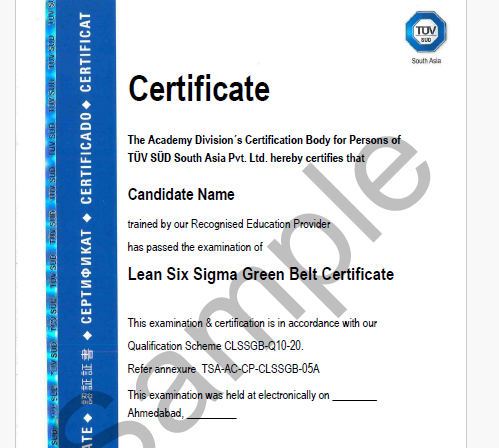

Lean Six Sigma Green Belt is an intermediate-level certification that focuses on advanced process improvement using the DMAIC methodology. It covers data analysis, statistical tools, and project management techniques required to lead improvement initiatives within organizations.
The training includes Lean principles, Six Sigma methodology, DMAIC framework, statistical analysis, hypothesis testing, process mapping, root cause analysis, quality control, and continuous improvement strategies.
This course is ideal for Quality Analysts, Project Managers, Business Analysts, Operations Managers, Engineers, and professionals involved in process improvement and data-driven decision-making.
While there are no strict prerequisites, having basic knowledge of Lean Six Sigma concepts or a Yellow Belt certification is recommended for better understanding of advanced topics.
Typically, Green Belt training takes 3 Full Days or approximately 24 hours, depending on the learning format and inclusion of practical projects.
Yellow Belt covers foundational concepts, Green Belt focuses on intermediate-level skills and project leadership, and Black Belt involves advanced statistical analysis, strategic decision-making, and leading large-scale transformation projects.
You will gain skills in data analysis, problem-solving, process optimization, project management, statistical tools, root cause analysis, and performance improvement.
DMAIC is applied by defining problems, measuring current performance, analyzing root causes, implementing improvements, and controlling processes to sustain results. Green Belts typically lead small to medium-scale improvement projects using this framework.
Industries such as manufacturing, healthcare, IT, finance, retail, logistics, and service sectors widely benefit from Lean Six Sigma methodologies.
Tools include process mapping, Pareto charts, fishbone diagrams, control charts, regression analysis, hypothesis testing, FMEA, 5 Whys, and statistical analysis techniques.
The exam generally consists of multiple-choice questions and scenario-based problems that test knowledge of DMAIC, statistical tools, and process improvement techniques.
The cost varies by provider but typically ranges between $300 to $800 USD. Some training programs include exam fees and study materials.
Yes, it is widely recognized across industries worldwide and valued by organizations for process improvement and quality management roles.
Yes, non-technical professionals can enroll. While some statistical concepts are involved, the training is designed to be accessible with proper guidance and practical examples.
Career opportunities include roles such as Quality Analyst, Process Improvement Specialist, Operations Manager, Business Analyst, Project Manager, and stepping stone roles toward Black Belt certification.
We go beyond teaching, we build careers.
Learn from industry practitioners with 10-20 years of real-world experience across enterprise teams.
Train for leading certifications across cybersecurity, cloud, AI, and governance tracks.
Get resume reviews, mock interviews, and personalized support for role transitions and growth.
Practice with guided labs, projects, and sandbox exercises aligned to real implementation scenarios.
Choose from live weekend, weekday, and fast-track formats based on your availability.
Stay supported with trainer access, learner community help, and dedicated coordination assistance.